

Last Updated: October 25, 2026
Quick Summary
UPF 50 clothing blocks about 98% of ultraviolet radiation, letting roughly one-fiftieth of ambient UV reach covered skin. Paddlers need it because water reflects UV from below while the sun hits from above, and there is no shade on open water. The rating only protects what the garment covers, so pair it with sunscreen on exposed skin.
- UPF 50 blocks about 98% of UV, while UPF 30 blocks about 97%.
- Wet, stretched, and worn fabric can drop real protection below the label.
- Look for an explicit UPF 50+ rating, flatlock seams, and thumb holes.
- Wash cold with mild detergent, hang dry, and rinse saltwater after every session.
- Our Hydro Hoodies use a 78% recycled polyester, 22% spandex blend.
Table of Contents
- What Does UPF 50 Mean and Why It Matters on the Water
- UPF Clothing vs Regular Clothing: The Fabric Difference
- Why Wear UPF 50 Clothing for Paddling and Long Days Outside
- How Long Does UPF Clothing Last?
- How to Choose UPF Clothing That Holds Up in Saltwater
- Comfort in Hot Weather: Breathability and Moisture-Wicking
- Shop Sun-Protective Gear Built for Paddlers
- Frequently Asked Questions
What Does UPF 50 Mean and Why It Matters on the Water
UPF 50 clothing blocks all but roughly one-fiftieth of the ultraviolet radiation that reaches the fabric, which is why it earns a place in any serious sun safety routine. On open water there is no shade to duck into and no second chance at your skin, so understanding what the number actually promises matters before you buy.
Ultraviolet Protection Factor is the clothing equivalent of SPF, except it measures fabric rather than lotion. The rating is a ratio: a UPF of 50 means 1/50 of the UV radiation that hits the fabric passes through, so about 2% gets through and 98% is blocked. That number only holds when the garment fits correctly, stays dry, and keeps its construction intact.
Reading the UPF Scale, Not Just the Number
The scale is not linear in the way shoppers assume, and the jump from 30 to 50 is smaller than the jump from no rating to 30:
- UPF 15 blocks about 93% of UV radiation
- UPF 30 blocks about 97%
- UPF 50 blocks about 98%
- UPF 50+ is the highest category and blocks more than 98%
A UPF 50+ label does not mean zero UV exposure. It means the covered skin receives roughly one-fiftieth of the ambient UV, which still adds up over a long session in reflected light. That is why the rating is a tool inside a routine, not a substitute for one.
UPF vs. SPF: Two Different Ratings
SPF applies to sunscreen and measures how long a product delays sunburn on exposed skin. UPF applies to textiles and measures how much UV radiation passes through the fabric itself. The two work as a system, not a substitute for each other.
Sunscreen needs reapplying through the day, especially after sweat and saltwater. Fabric protection does not wear off the same way, though it does degrade with stretch, wear, and soaking. For long paddles, that reliability is the whole point.
If you want a deeper walkthrough of fabric ratings and fit before you buy, our UPF 50 long sleeve shirts buyer's guide covers the selection side in detail.
Here is how the UPF scale breaks down, from no rating to the highest category.
| Rating | UV blocked | Note |
|---|---|---|
| UPF 15 | About 93% | Lower protection tier |
| UPF 30 | About 97% | Mid-range protection |
| UPF 50 | About 98% | About 1/50 of UV passes through |
| UPF 50+ | More than 98% | Highest category |
UPF Clothing vs Regular Clothing: The Fabric Difference
The gap between UPF clothing and regular clothing comes down to construction, not magic. A standard cotton tee might offer modest protection while dry, then lose much of it once soaked with sweat or seawater. Purpose-built sun-protective clothing is engineered to hold its rating under those conditions.
Weave, Density, and Fiber Type
Three variables decide how much UV gets through:
- Weave tightness: tighter weaves leave smaller gaps between threads for ultraviolet rays to slip through
- Fabric density: heavier, denser knits block more UV penetration than loose, open knits
- Fiber type and treatment: some synthetics and treated fabrics absorb or reflect UV more effectively than untreated natural fibers
Color matters less than most people assume, and stretch matters more. A garment pulled tight across the shoulders can transmit more UV than the same fabric hanging loose.
That is why a plain rash guard and a rated sun hoodie are not interchangeable. One is a barrier by accident. The other is a barrier by design.
Why Wear UPF 50 Clothing for Paddling and Long Days Outside
Paddlers need UPF 50 clothing because they spend hours in reflected UV with no natural shade. Water bounces ultraviolet rays back at you from below while the sun hits from above, so exposed skin takes a double dose.
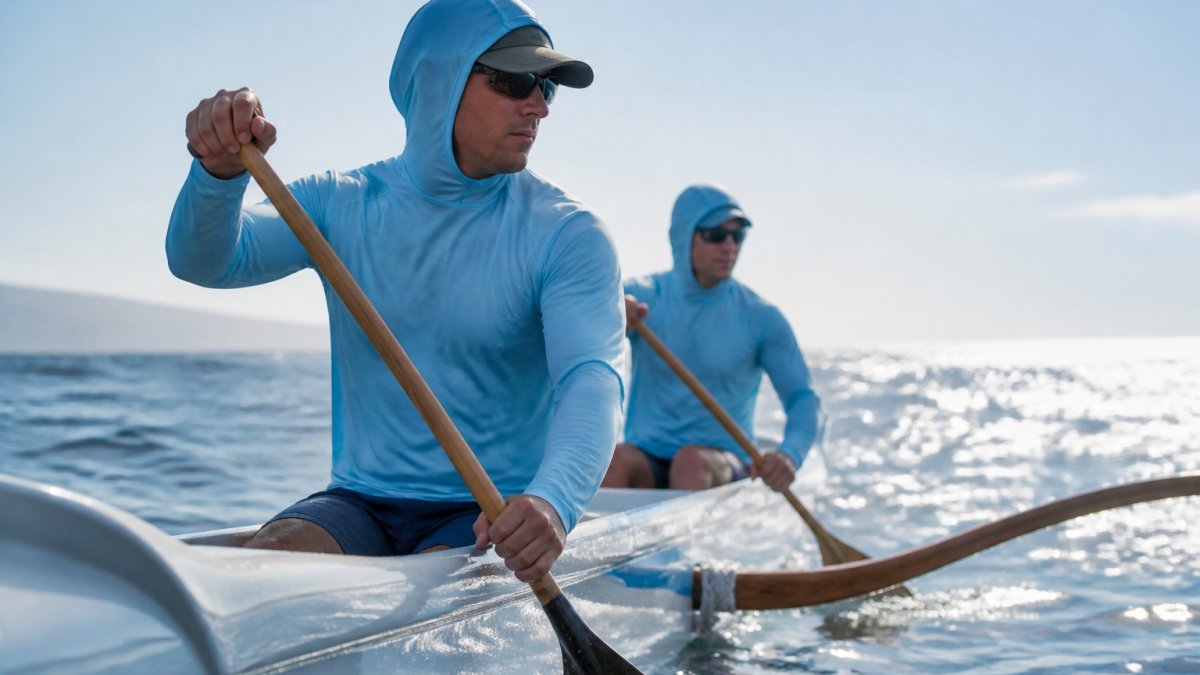
The American Cancer Society guidance on UV exposure is blunt about cumulative damage: every burn adds to lifetime risk, and skin damage builds quietly over years of sessions. That is the case for year-round protection, not just summer.
Coverage Limits and Exposed Skin
A UPF 50 garment only protects what it covers. Hands, neck, ears, and the strip of forehead under a cap stay exposed unless you plan for them. Thumb holes, a buttoned hood, and a brimmed cap close most of those gaps.
Watch out: a high rating on the chest panel means nothing if your sleeves ride up mid-stroke. Check coverage in motion, not standing still in a mirror.
How Long Does UPF Clothing Last?
Most quality UPF clothing holds its rating for years with proper care, but the protection fades faster with harsh washing and heavy wear. The rating is not a permanent sticker. It reflects the fabric as manufactured and as tested, and that fabric changes with use.
What the Label Actually Certifies
A legitimate UPF claim is backed by laboratory testing, typically following an established textile standard that measures UV transmission through fabric in both dry and, in some protocols, wet or stretched states. The label should state the rating plainly, and makers are expected to substantiate protection claims under FTC guidance on textile labeling and advertising claims. A vague "sun protective" phrase without a number is not the same as a tested UPF rating.
Men's Hawaiian Hydro Hoodie - Big Kahuna Print →
When Real Protection Drops Below the Rating
The stated UPF assumes the fabric is intact and reasonably fitted. Real-world conditions can push actual protection below the label:
- Wet fabric: water fills the gaps between fibers and can reduce protection, which matters for paddlers soaked by spray and sweat
- Stretched fabric: fabric pulled tight across shoulders and knees opens its weave and transmits more UV
- Worn fabric: abrasion, pilling, and thinning at high-wear points lower protection before the garment looks worn out
- Faded or degraded treatments: some finishes that boost UV absorption diminish with repeated washing
What Shortens and Extends Garment Life
What shortens a garment's protective life:
- Chlorine and repeated hot washes that break down fibers
- Fabric stretched thin at the shoulders and knees
- Abrasion from boards, straps, and PFD buckles
- Sunscreen residue and salt left to sit between sessions
What extends it:
- Cold or cool machine wash, mild detergent, hang dry
- Rinsing saltwater out after every session
- Rotating two garments instead of hammering one
- Retiring any piece that has gone thin, pilled, or see-through in sunlight
Hold a worn garment up to a bright window. If light passes through easily, the weave has opened up and the protection has dropped with it. When in doubt, treat a heavily worn garment as ordinary clothing and pair it with sunscreen on the skin it covers.
How to Choose UPF Clothing That Holds Up in Saltwater
Choosing UPF clothing for saltwater comes down to verifying the rating, checking the seams, and testing the fit in motion. Salt, sun, and repeated washing are a punishing combination, and not every garment labeled sun-protective survives it.
Use this checklist before you commit:
- Look for an explicit UPF 50+ rating on the label or product page, not a vague "sun protective" claim
- Confirm flatlock seams, which sit flat against skin and reduce chafing under a PFD
- Check for thumb holes or extended cuffs to cover the backs of your hands
- Verify the hood has a closure so it stays put over a cap in wind
- Read the fabric content and confirm it is quick-drying
- Test range of motion with a simulated paddle stroke before purchase
The FTC guidance on textile labeling and advertising claims is worth knowing: makers are expected to substantiate protection claims, so a legitimate brand should state the rating plainly.
For us, the standard is simple. Our Hydro Hoodies use flatlock seams, integrated thumb holes, and a button-closure hood precisely because those are the failure points on long water sessions. Charlotte Nurok, a six-man Hawaiian canoe steersman, and downwind athletes like Rory Frampton put gear through exactly that kind of abuse.
Comfort in Hot Weather: Breathability and Moisture-Wicking
Breathability and moisture-wicking decide whether you actually keep the garment on. A sun shirt that traps heat gets pushed up the arms or peeled off entirely, which defeats the purpose.
Look for three things: a lightweight knit, moisture-wicking fibers that pull sweat off the skin, and quick-drying construction that recovers between sessions. Our hoodies use a 78% recycled polyester, 22% spandex blend that dries fast and moves with the stroke instead of fighting it.
The recycled content is not a gimmick. Each yard of fabric keeps roughly 13 bottles out of the waste stream, and our gear is built from recycled ocean-bound plastic because the people wearing it care about the water they paddle on.
Shop Sun-Protective Gear Built for Paddlers
The best sun-protective gear is the gear you will actually wear every session. Coverage you skip is coverage you do not have. That is why we design around fit and comfort first, then layer the protection on top.
Our men's Hawaiian Hydro Hoodie in the Big Kahuna print and the women's version of the same print both carry SPF 50 protection, moisture-wicking fabric, flatlock seams, thumb holes, and a button-closure hood.


We are the official jersey provider for the Kimokeo Hawaiian Outrigger Voyaging Society and Hawaii's Pu'ali Koa Kahiko, and the preferred choice for team jerseys on Maui. Our gear is designed by paddlers, for paddlers, and tested on the water it was built for.
Frequently Asked Questions
What does UPF 50 mean in clothing?
UPF stands for Ultraviolet Protection Factor. A UPF 50 rating means the fabric allows roughly 1/50th of UV radiation to pass through, so it blocks about 98% of ultraviolet rays. That is a measurable rating applied to the fabric itself, not a spray-on treatment. UPF 50 clothing is the highest tier most labels carry, which is why it appears on sun-protective shirts, hoodies, and jackets made for long days outside.
Is UPF 50 clothing better than sunscreen?
They solve different problems. Sunscreen needs reapplying every couple of hours and washes or sweats off, while UPF 50 clothing blocks UV radiation continuously as long as you wear it. For long paddles, races, or beach days, a UPF 50 shirt or hoodie removes the guesswork. Most dermatologists still recommend sunscreen on exposed skin, so the practical answer is both: cover what you can with UPF clothing and use broad-spectrum SPF on your face, neck, and hands.
How long does UPF clothing last, and does washing ruin it?
Fabric-based UPF protection is built into the weave and fiber, so it does not wash off the way a topical treatment would. How long UPF clothing lasts depends on wear: repeated stretching, abrasion, and heavy chlorine exposure can thin the fabric and reduce protection over time. Wash in cold water, skip fabric softener, and air dry. When a garment gets noticeably stretched, worn thin, or see-through in sunlight, retire it.
Do you need sunscreen under UPF 50 clothing?
Only on skin the garment does not cover. UPF 50 clothing blocks about 98% of UV radiation where fabric sits, but the neck, ears, face, hands, and any gap at the wrist or hem are still exposed. For paddlers, thumb holes and a button-closure hood close two of the biggest gaps. Apply broad-spectrum SPF to whatever is left uncovered, and reapply through the day.
The sun does not take a session off, and neither should your protection. If you are ready to stop reapplying and start paddling, get started with Silverback Hawaii and gear up in sun-protective hoodies made from recycled ocean-bound plastic, with flatlock seams that prevent chafing and quick-dry fabric built for back-to-back sessions.
